
Completion
Primary Completion Procedures
Once a well has been drilled, the decision must be made: Can this well become a productive? Some wells are thoroughly tested to "try" and determine profitability before completion, but these methods are no where near precise. Modern shale well are not even tested before completion. Since a stimulation technique is needed in order for them to be productive test results at this point are not accurate. If the well is determined unproductive it is plugged and abandoned. If its is deemed productive the completion process is started. Well completion incorporates the steps taken to transform a drilled well into a producing one. These steps include casing, perforating, stimulation and installing production equipment.
Casing
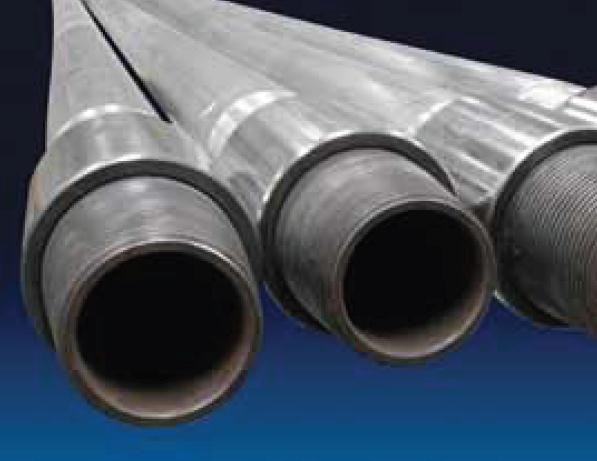
The first step in completing a well is to case the hole. Casing ensures the well will come deteriorate as well as isolate the producing formation. Casing is a series of 30ft joints of steel pipe which are screwed together to make what is referred to as a continuous ?casing string?. There are different levels of casing, these include production casing, intermediate casing, surface casing and conductor casing. The casing string (or sometimes various strings) runs the entire length of the well. It is lowered into the hole and cemented in place.
Perforation

In order to achieve production, the casing and cement are perforated to allow the hydrocarbons to enter the well bore. This process involves running a perforation gun into the wellbore, Once the reservoir level has been reached, the gun then shoots holes in the sides of the casing to allow the hydrocarbons to enter the well bore.
Stimulation
Stimulation is performed on a well to increase production. Sometimes, a well initially exhibits low permeability, and stimulation is employed to commence production from the reservoir. Other times, stimulation is 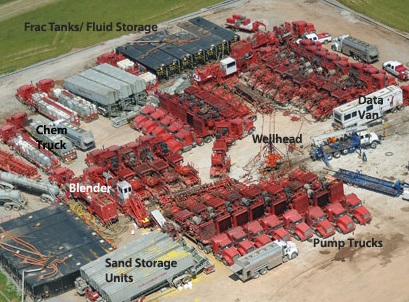 used to further encourage permeability and flow from an already existing well that has become under-productive.The Oil and gas industry has been utilizing well stimulation (including hydraulic fracturing techniques) since long before ?fracking? became a household term. The most common techniques are Acidizing and Hydraulic Fracturing (Fracing).
- Acidizing is performed in an effort to increase the permeability of the reservoir rock. Well acidizing is achieved by pumping acid into the well to dissolve limestone, dolomite and calcite cement between the sediment grains of the reservoir rocks. This process enlarges the existing voids to improve permeability.
- Fracing s a technique in which rock is fractured by a pressurized liquid. The process involves the high-pressure injection of 'fracking fluid' (primarily water, containing sand or other proppants) into a well to create cracks in the specific rock formations through which oil and natural gas will flow more freely. When the hydraulic pressure is removed, the frac fluid flows out leaving small grains of proppants to hold the fractures open. It makes existing small fractures larger and creates new fractures which allow the hydrocarbons to flow into the well bore.
 Production equipment
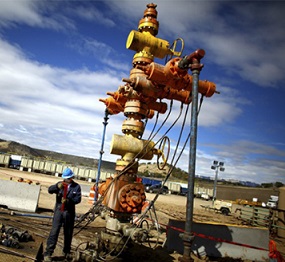
The only thing visible at the well head after the drill rig leaves the site is a series of valves and gauges connected vertically to each other and attached to the top of the well. This allows the amount of hydrocarbons to flow from the well and it prevents leakage at the surface. This structure is referred to as the Christmas Tree (see image).
All of the techniques discussed thus far for removing the hydrocarbons from the reservoir and bringing them to the surface are referred to as Primary Recovery Techniques. Primary techniques rely entirely on natural forces within the reservoir trap. And primary recovery accounts for a large portion of the total volume of hydrocarbons in the trap, but not all of it. Less than 40% of hydrocarbons present are recoverable by means of Primary Recovery.

In most reservoir traps, initial pressure is sufficient to push the oil to the surface of the production well with only minimal help from a down hole pump. But, with declining well pressures, it becomes more difficult to get the hydrocarbon to the surface. Sometimes, artificial OIL lift (pumping unit) is needed.
Completion Procedures
Completion and Equipment Procedure
- Move in work over rig
- Run a cased hole bond log, gamma ray log, and collar locator
- Run in the well bore with a perforating gun and perforate the well at the area of production
- At this time stimulate the well if needed. Some wells need multiple stages of stimulation.
- Run in the well bore with production tubing and set packer above producing zone
- Flow well back
- Test well for oil and gas production quality and quantity
- Set-up storage tanks and stairwell, heater treater, tank battery, separator, water tanks, flow lines, meter loop, gas lines
- Contract with gatherers for sale of oil and gas.

Completion cost
Casing
Modern wells have several sets of casing (steel pipe) cemented into the ground. A typical well will have conductor, surface, intermediate, production casing and tubing totaling tens of thousands of feet for a single well bore. For a horizontal well casing, pipe and tubing cost can quickly exceed $750,000.
Well stimulation
With modern horizontal wells, well stimulation is one of the biggest cost in the entire project. The most common stimulation is a technique called Hydraulic Fracturing. Its a process where fluid and sand are forced downhole at high pressure to open up the producing formation. It large horizontal wells this process takes an enormous amount of equipment and personnel to complete. Costs for modern fracturing techniques can quickly exceed $3,000,000 depending on the lateral length.
Surface Equipment
Producing wells take a large about of surface equipment to operate. Holding tanks, pumping units, metering stations, gas compressors, separators, pipelines and dehydrators are some of the heavy equipment needed to establish and maintain a producing well. The footprint for surface equipment on a typical well encompasses about an acre. Surface equipment for a single well can easily cost $750,000 or more.
Pipeline cost
Gas wells and sometimes oil wells need to be connected to a pipeline network in order to get the product to market. For most wells, nearness to gas pipelines are one of the most important considerations. In addition to the the physical pipe and dirt work needed to construct the pipeline, the easements that must be attained from every property owner in which the line will cross are also a major expense. This process for the initial well on a drilling site can take several months to complete. These cost are directly related to the length of pipeline that is needed. In some cases pipeline connecting may only cost $75,000 but others it may exceed $1,000,000.
VIDEOS
Rigging Up
Walking Rig
Walking Rig Ram Actuator
Drilling Rig Drone footage
Frac Job Drone footage
Drilling Rig Tour
Drilling Rig Tour from Lee Novikoff on Vimeo.
Horizontal Shale Drilling
Horizontal Shale Drilling from Lee Novikoff on Vimeo.
Drilling Process
Tidal Petroleum Video from Lee Novikoff on Vimeo.
Directional Drilling
Fracing
Pumping unit
Prospects

While all of the parameters mentioned above must be met before drilling for hydrocarbons can begin, a key element that has to be determined before leases and permits are obtained is deciding WHERE to drill. Anyone can drill an oil well anywhere if there is enough money, but the primary purpose is to locate hydrocarbons. Thus finding the right location, one where there is a propensity of information supporting the idea that oil exists beneath it, is of paramount importance. Oil sites have been sought using a variety of different techniques. For example, in the early days oil was found by wandering about the countryside with an open flame, a little optimism, and a lot of adventure. Others have used exploration philosophies ranging from drilling old Indian graves to putting on an old hat and galloping about the prairie until the hat comes off and drilling where it lands.
One of the earliest exploration tools was referred to as Creekology. Early drillers recognized a connection between river bottoms and the occurrence of hydrocarbons but didn't understand why. It wasn't until later that the anticlinal theory was developed which explained the phenomenon.
This random approach to hydrocarbon exploration has resulted in locating oil, but, more often than not, the culmination has been a dry hole. The application of geology to hydrocarbon exploration is a recent development.

Evaluating a prospect (a location where a well could be located to discover hydrocarbons in commercial quantities) relies upon the answers to two questions: What is the likelihood of finding hydrocarbons at this site, and are the economics such that it will create a sufficient profit margin to justify the expense of drilling? Geology is used to help answer the first question while economic projections and market analysis help answer the second. Even though geological methods are utilized in the hunt for hydrocarbons, it doesn't always provide all of the answers to all of the questions. While the scientific method is a valid approach, the results are only as good as the information that was used. And the same holds for the economic analysis. World demand for oil and gas is in a constant state of unrest. Political stability, weather (cold winters in the northeastern United States), consumer demands (increased travel during holiday periods), and supply drastically affect prices. Financial risk versus potential profitability must be established, and this requires the probability of geological success (discussed earlier) and three commercial parameters:
- Potential profitability of venture,
- Available risk to investment funds, and
- Aversion to risk.
The interplay of all three criteria produce a subjective evaluation of the economics of the prospect.
But one other aspect of the prospect is also important and that is whether the well in question will be drilled in an existing field (where producing wells currently exist) or is a new prospect (an area where no oil or gas wells exist). Each type carries with it a different degree of risk, but also a different degree of potential reward. So defining the prospect is a difficult and an inexact science. Exploration techniques utilizing geological methods are the primary means used to locate prospects.
Techniques
Techniques

Deciding where to drill is the most in-depth part of Exploring for oil and gas. The Modern exploration geologist (a person who explores for petroleum) must rely on many techniques to find profitable oil and gas reserves. There are three primary methods used to find hydrocarbons in the subsurface:
- Geophysical surveys
- Sub surface mapping
- Wildcatting
Sub Surface Mapping

The search for hydrocarbons frequently begins with the analysis of sub-surface terrain, well production,
and previous well test data. These types of programs normally focus on finding undeveloped reserves in older fields. These reserves may stem from overlooked production intervals or residual oil and gas left improve formations. Many oil and gas fields were abandoned at times where oil and gas prices were substantially lower than today. When wells cost more to operate than they generate they are plugged and abandoned. The volatility of oil and gas demand and prices may cause a field that was once non-profitable, to be a viable option at a later date. The most recent market condition has been by way of technological advances in drilling, completion and stimulation techniques. Some very well mapped areas, such as the Eagle Ford Shale have never been economical viable, but are now among the most profitable formations in the United States. This market condition has brought about tremendous potential for developmental oil and gas programs. The data from previous wells can be used to help pinpoint the optimum location for new wells to extract the reserves. These programs generally offer a lessor degree of risk.
Geophysical Surveys

Geophysical techniques used for exploration utilize equipment to measure the following: electrical currents, gravitational and magnetic anomalies, heat flow, geo-chemical relationships, and density variations from deep within the earth. Each technique records a different set of characteristics, which can be used to try and locate hydrocarbons beneath the surface of the earth.
Seismic surveys use vibration (induced by an explosive charge or sound generating equipment) to provide a picture of subterranean rock formations at depth, often as deep as 30,000 feet below ground level (BGL). This is accomplished by generating sound waves downward, which reflect off of various boundaries between different rock strata. The sound waves are generated by small explosive charges embedded in the ground or by vibrator trucks, sometimes referred to as thumpers, which shake the ground with hydraulically driven metal pads.

The human ear can barely hear the thump, but the frequency generated penetrates the earth's crust. The echoes are detected by electronic devices called geophones which receive the reflected sound waves. The data is recorded on magnetic tape which is printed to produce a two-dimensional graphic illustrating the subsurface geology.
In this type of survey, sound waves are sent into the earth where they are reflected by different layers of rock. The time taken for them to return to the surface is measured as a function of time. This measurement reveals how deep the reflecting layers are; the greater the time interval' the deeper the rock layer. Moreover, this technique can also determine what type of rock is present because different rocks transmit different sound waves.
Wildcat

A true wildcat well is one that is drilled in a new area where no other wells exist and generally with little information. It is drilled in an effort to locate undiscovered hydrocarbons, About 1 in 10 wildcat wells strike oil or gas, but reserves can be extremely profitable when these programs are successful. Many wildcat wells are drilled on a hunch, intuition, or a small amount of speculative geology. Many times they are based on surface trends, photography and experience in a particular area.
Before Drilling
Before you can begin drilling for hydrocarbons, there are a couple of issues that need to be resolved. For example, where will the drill rig be placed? On whose land? Do you have permission? Do you own the mineral rights to remove the hydrocarbons once they are discovered? Have you obtained the proper permits from a myriad of governmental agencies? How do you know that oil and gas are present beneath the drill rig? There are a number of considerations before the drill rig begins operations. These activities generally fall into the broad categories of mapping, leasing, and permitting.
Mapping

Mapping deals with land surface determinations and measurements. It is the methodology by which we describe where things are located. In a world where individual property ownership is practiced, such a description has legal application. A legal description for a parcel of land is analogous to what a street number and street name, city, state, and zip code are to a mail carrier. The legal description gives surveyors and property owners a mechanism by which to precisely locate tracts of real estate. It also allows property to be transferred, leased, and mortgaged.
An accurate surface map facilitates determining land ownership above the hydrocarbons and who owns the minerals beneath the surface; seldom are the mineral and surface owners the same.
Leases

The concept is simple, but most people do not understand what the system is or how it works. But it is utilized to establish well locations, to determine land ownership, to assign mineral rights, and to accurately plot property lines and boundaries. Drill rigs are very large pieces of equipment. When combined with the support equipment, supplies, work force, and access roads, the total area needed for a drilling operation can easily exceed 40 acres in size.
Drilling and production companies must know ownership before they can proceed with their plans. Permission to conduct operations must be obtained from both parties. This job is usually that of a Landman, a person whose job it is to seek out the owners of both estates and negotiate leases and contract with them on behalf of the production company for the right to drill and withdraw the hydrocarbons.
Permits

Each state and county has a regulatory body that oversees petroleum operations. The regulatory body requires a number of permits for such things as drilling on public land, off shore (within the three-mile limit), and along the coastline. In Texas, the governmental agency responsible is the Texas Railroad Commission. It regulates location and construction of prospect wells, requirements for fresh water protection in vicinity or drilling, formation drainage allocation, and well to well spacing requirements.
Drilling Rigs
The drilling process is a very in-depth process. A well site must first be selected then all the legal documents obtained. Drilling operations can begin only after the site has been prepared, ground has been leveled, roads have been built, a derrick has been erected, and other equipment that comprises the drill rig has been put in place. Water is a vital component in the drilling process for mixing drilling mud (lubricant). Water can be hauled into the location by trucks or pumped from a nearby lake, pond, or water well. If no source is available, a new water well must be drilled before the drilling process can begin.

The most common drill rigs are of the rotary rig type (see image). Today's rotary drill rig consists of multiple engines that supply power, hoisting equipment that raises and lowers the drill string (drill pipe), and rotating equipment that turns the drill string and the drill bit. These engines also drive the circulating equipment that pumps liquids (mud) down the hole to lubricate the drill string and drill bit which are rotating in the hole. These liquids remove cuttings (loose bits of rock), and controls down hole pressure to prevent blowouts (unexpected pressure, which overcomes the weight of the drilling mud and explodes to the surface).
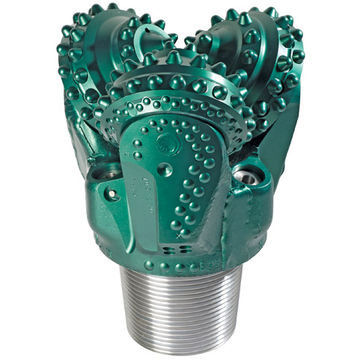
The conventional drill bit has three movable cones containing teeth made of tungsten carbide steel and sometimes industrial diamonds (see image). The rotating cones are the cutting heads. The downward force on the drill bit is the result of the weight of the overhead drill stem (steel pipe, pipe joints called collars) and drilling equipment on the derrick all of which can amount to thousands of pounds. Keep in mind that the entire pipe and bit assembly rotate together in the hole.
While the bit cuts the rock at the bottom of the hole, surface pumps are forcing drilling fluids down the hole through the inside of the drill pipe and out the bit. This fluid lubricates and removes cuttings. The fluid (with the cuttings) then flows out the center of the drill bit and is forced back up the outside of the drill pipe onto the surface of the ground where it is cleaned of debris and pumped back down the hole. This is an endless cycle that is maintained as long as the drill bit is turning in the hole. The drilling crew is under the supervision of the Driller. The person who works on a platform high in the derrick is called a Derrickman; he has the very dangerous job of handling the upper part of the drill stem as it is raised and lowered. Roughnecks are the workers on the derrick floor; their job is to add new pipe joints as the well depth increases. The entire crew and operation of the rig is under the supervision of the Tool Pusher. A typical drill rig will operate 24 hours per day, 7 days per week. It never shuts down for holidays.
Drilling Procedures
Drilling and Testing Procedures
- File permits
- Build Location
- Move rig on location and rig up
- Drill surface hole and set surface casing
- Complete drilling of the well
- Log the well and run any other test that may be needed (i.e. cores, drill stem test, etc.)
- Either plug the well as a non-producer or set and cement the casing.

Drilling Cost
Leases
The right to enter and drill on the property owner's land is accomplished by obtaining a lease. The lease is subject to title search and proper recording in much the same way as real estate. Many times the bonus for a mineral lease exceeds the value of the property itself. Between legal cost for title work and lease bonus wells see costs in excess of $1,000,000 for leasing alone. Some leases with multiple mineral and land owners take several months if not years to negotiate and finalize.
Site Preparation
Most times, a road must be built to the site. Good roads are a necessity in order for trucks and heavy equipment to reach the well. Once at the site, a level area is cleared about 2/3 the size of a football field. Bulldozers, dump trucks, excavators, and road graders are typically used for this process. General this process takes between 2 and 3 weeks, but if extensive road work is needed it can take much longer Construction of roads and drilling site is a major cost factor which can easily exceed $400,000 per location.
Drilling
When the site is prepared, the drilling rig can be moved into position. A rotary rig is the modern equipment used. It is capable of drilling over 1,000 feet per day through use of a rotary bit driven by huge engines. Fluid or air if forced under pressure down the center of the drill stem to clean out the hole continuously during drilling. The drilling operation is a very complicated one requiring enormous amounts of planning and teamwork. A modern drilling project can encompass the use of 30-40 different individual companies to fully complete the process. Cost depend on the depth and complexity of the well. Modern horizontal well drilling costs can easily exceed $4,000,000 just in the drilling phase. Without drilling complications these wells generally take about 3 weeks for the drilling phase.
Rig Mobilization
Moving a drilling rig is not a simple task. Every time a well is drilling a drilling rig must be moved in and assembled. The process normally takes 3-5 days. After the well is drilled the rig must be cleaned and disassembled and moved off location. Rig mobilization and assembly expenses vary depending on how far the rig must be transported, but generally run between $100,000 to $350,000..
Miscellaneous costs
Costs outlines above are only some of the cost incurred preparing, drilling, completing and producing of an oil or gas well. in total, this complete process will encompass 40-50 different individual contracting companies and hundreds of additional minor expenses.